
Still, many look at the wooden wheels used on nineteenth-century wagons, stages, and carriages as some type of rustic, tree-borne saucers barely advanced enough to roll. Apparently, it's amazing that these perceived cave man creations could be a complicated piece of machinery. In truth, these levers of progress deserve to be more than overlooked and underappreciated. From hub to spoke and felloe to tire, they're a fusing of craftsmanship, resourcefulness, dendrology, metallurgy, art, science, and engineering expertise. Just putting one together is a challenge. Keeping it together as an efficient and practical design is another thing entirely. Pitch, gather, and dish all work to instill the right draft, muscle, resilience, and durability of the vehicle. Reinforcing these thoughts, there were countless methods of wheel construction during the 1800s and early 1900s. Among the more recognized today are those with a Sarven hub design. This pre-Civil War idea involves a metal housing surrounding an inner wooden hub. With the initial patent granted on June 9, 1857, James Sarven introduced his concept to a less-than-enthusiast industry.
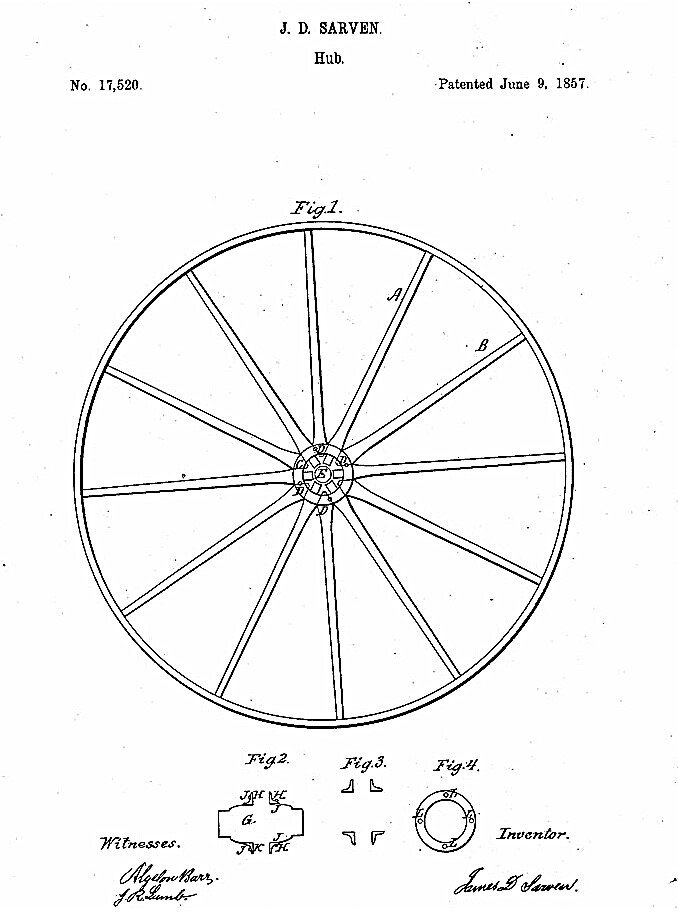
Segment from original 1857 Sarven patent. Image Courtesy of Wheels That Won The West® Archives.
The April 1904 issue of "The Carriage Monthly" included a story focused on the history of the Sarven design and I thought I'd share some of that history this week...
"About 1856, J.D. Sarven, conducting at that time, business in Columbia, Tenn., conceived the idea of making a strong light wheel by using a very light wooden mortised hub. Instead of staggering the spokes to give them strength, as had always been done on light wheels, he mitred (sic) the shoulders of the spokes so as to form a solid arch on the outside of the hub. In order to give lateral support to the spokes forming the arch, he brought a metallic flange to bear on each side and connected them with rivets and bolts, thus making a strong wheel retaining the same elasticity as those previously made entirely of wood.
Upon this wheel he obtained a patent, but met obstacles in its introduction: carriage builders did not take to it kindly, as it was an innovation, and it was some time before its self-evident merits were recognized. Failing to make it go, he sold the exclusive right to manufacture it to Woodburn & Scott, of St. Louis, and the New Haven (Conn) Wheel Co. These manufacturers found the same difficulty and encountered much opposition and prejudice, and in a very determined form. After several years of effort, they began to meet with success."
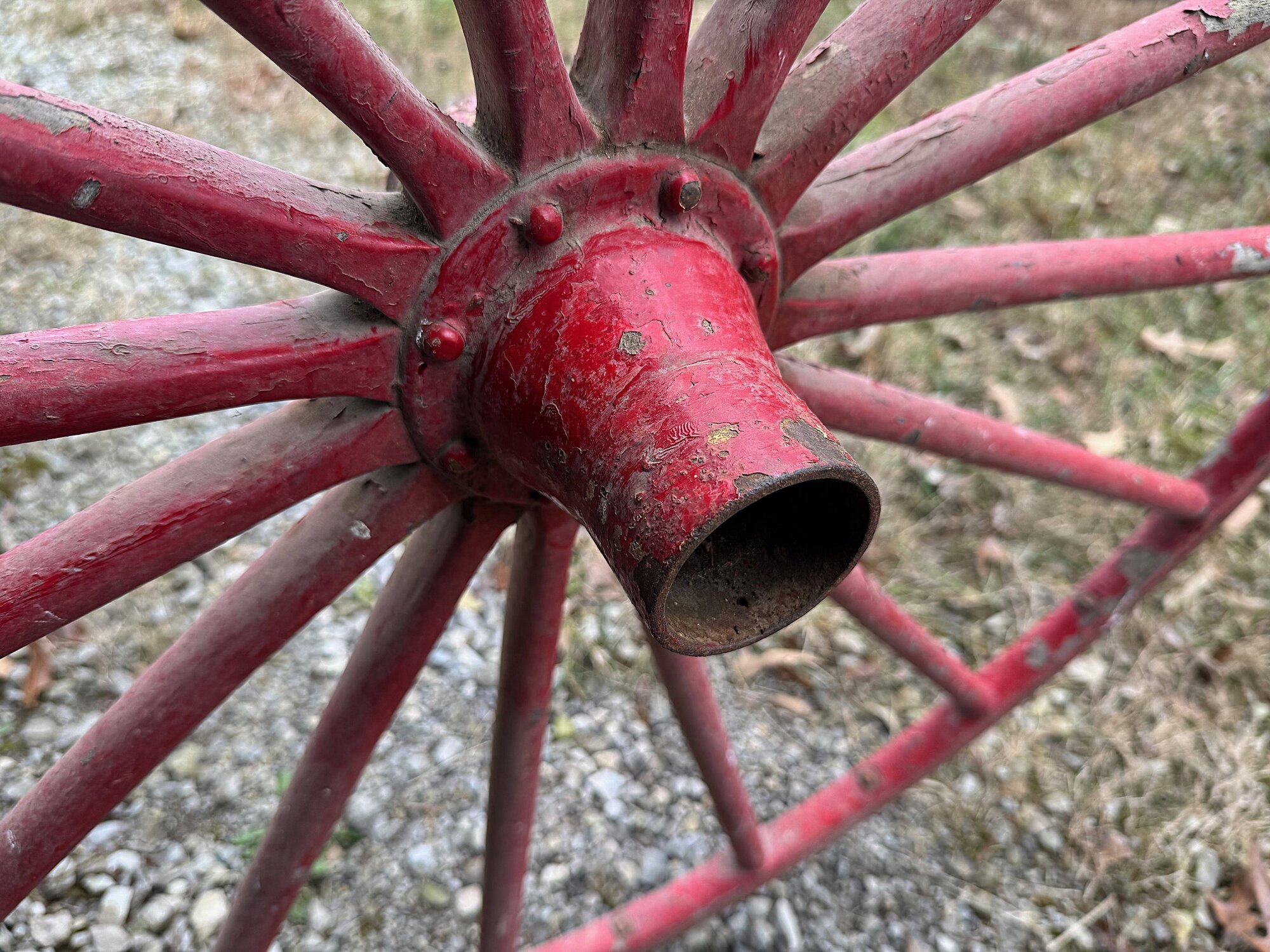
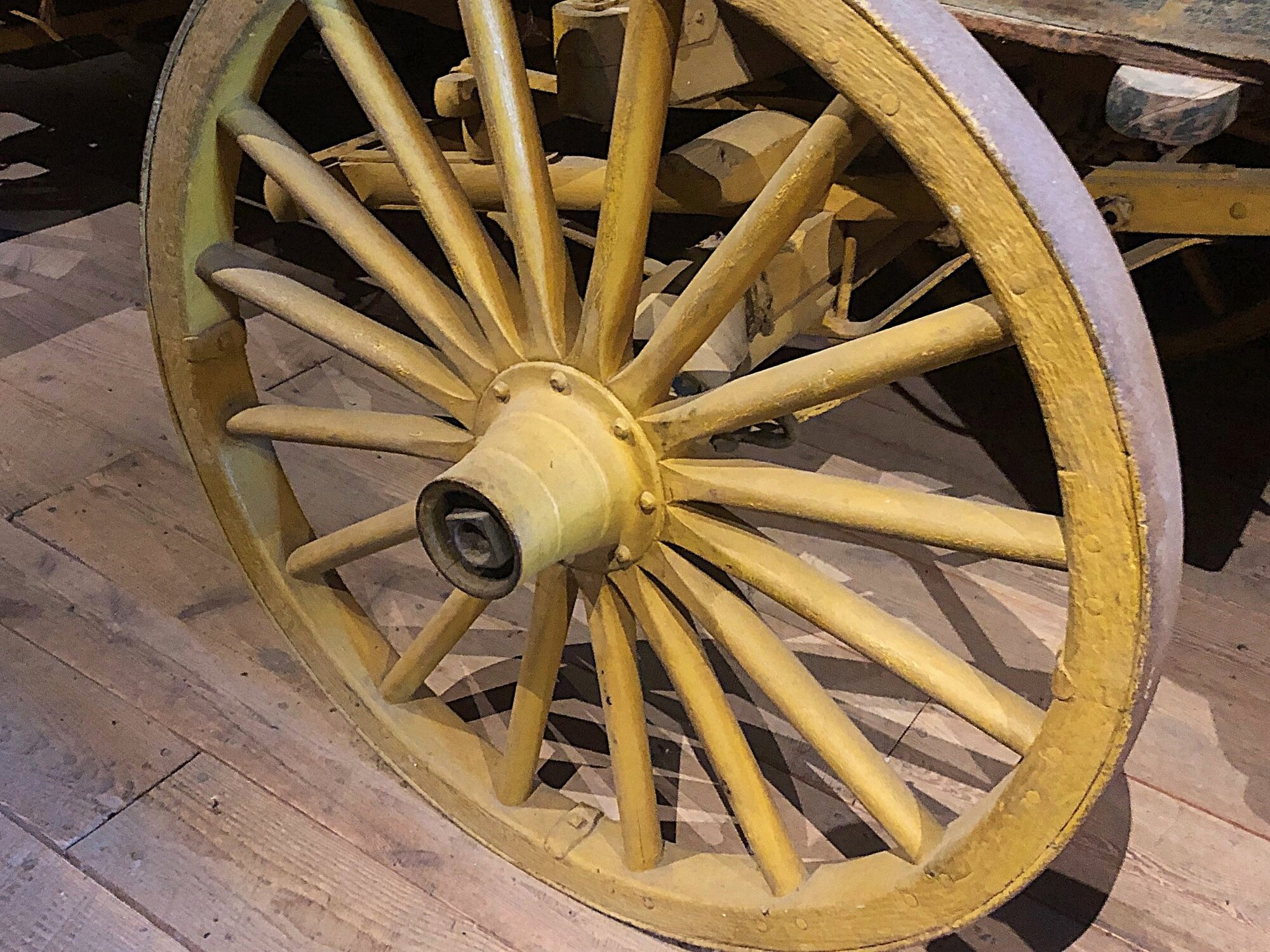
A Sarven hub on a Milburn brand farm wagon. Available in different sizes, this type of hub was used on a number of early, horse-drawn vehicles including buggies, carriages, stages, city, business, express, freight, and farm wagons. Image Copyright © David E. Sneed, All Rights Reserved.
Per the 1904 article, "In 1872, three companies were manufacturers of the Sarven wheel as lessees, namely, Woodburn-Sarven Wheel Co., Indianapolis, Ind. (began in 1848); Royer Wheel Co., Cincinnati, Ohio, and the New Haven, Conn., Wheel Co. This patent expired June 8, 1871, but was extended seven years."
Once the Sarven wheel finally started being accepted, there were numerous copycat designs trying to take advantage of the opportunity. The infringing parties were soon hit with litigation and the Sarven design was successfully defended in the end. Even so, the legalities didn't stop others from looking to improve on the concept. One of those Sarven-type designs was patented in 1900 for automobiles. Another was a ball-bearing addition to the Sarven hub and still another was a metal band with additional flanges supporting the spokes. James Sarven, himself, also had other patents, including one for a machine to bend wood, another for body support irons, and multiple others for vehicle springs.
Why is any of this information relevant? That's a little like asking why should I care what truck is best suited for a specific need? In order to understand distinctions between the rarest of vehicles as well as what each is capable of achieving, we must know something about its features. Likewise, if we need maintenance done, we should be able to recognize when things are not up to par or performing correctly. Understanding any vehicle goes well beyond admiring the look and feel. For ages, wheels have been crucial to the majority of the transportation world and awareness of and appreciation for this footing can give collectors real advantages when looking for special pieces.
One final thought... for those who might still feel the subject of wheels for antique, horse-drawn vehicles is for lightweights, once we have the details of the Sarven wheel mastered, the good (or bad) news is that there are plenty of other hub designs waiting to be conquered and added to a repertoire of knowledge. The Warner, Sterrick, Vulcan, Thresher, Whelan, Dorman, Shell band, Watson, Olds, Banded Curtis, Bradley, MacKinnon, Archibald, Sweet's, Mandt, Iron Clad, and many many others were part of everyday life and competition during the horse and buggy days. With countless patents on virtually every part of these old wheels (including spokes, tires, and felloes), there's little likelihood that anyone will be writing a complete story on the circles of Sarven and all the other competitors from the period.
By the way, if you haven't signed up to be notified when we update our Articles, Blogs, and other parts of the 'Wheels' website, it's easy. Just click on the 'SIGN UP' link in the upper right of any of our website pages and leave your email address. We'll take it from there.
Have a great week and thanks for your regular visits!
David
Ps. 20:7