
Collecting America's early wagons and wood-wheeled transportation is fraught with challenges. Navigating the vernacular, designs, eras, and innovations can be a bit overwhelming. After all, these are supposed to be 'simple' vehicles, right? Except, they are anything but!
Another issue we can encounter is the problem of recognizing and then discerning between brands of the same name... especially if the city-state info for the maker is not visible on the wagon. Well-known icons like Bain, Ozark, Smith, Springfield, Florence, Fish Bros., and more were plagued with same-name competitors. As confusing as it might have been in the nineteenth and early twentieth centuries, for collectors today, it can be even more frustrating. Not only were the duplicate brands confusing, for retail rivals, it could be downright maddening. While many firms carried on the best they could, others took their cases to court. In the process, more than one builder litigated their way out of business.
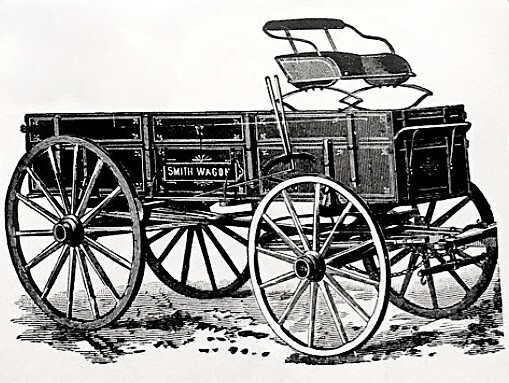
This 'Smith' brand wagon from Minnesota is not the well-known 'Smith' label that was the predecessor of the Pekin Wagon Company. Lineages and brand history can have a lot to do with collector values. Image Courtesy Wheels That Won The West® Archives.
In some instances, the industry itself seemed to grow weary of questionable name choices. Such was the situation in a May 1909 article in "Farm Implement" magazine. Apparently, some in the industry had reached a breaking point as to what defined respectable competition. Under the headline, "More Deception Exposed," a lengthy story unveils what was believed to be underhanded tactics being employed by a large mail order house. Even though the company was not called out by name, it seems clear the write-up was focused on the marketing methods of Montgomery Ward. Here's the transcribed report...
"Our attention was called recently to the price quoted by a mail order house on farm wagons, and we started an investigation, the result of which may prove interesting to our readers. It is but another evidence of the deception practiced by many direct selling concerns.
Our member discovered on his depot platform a brightly painted farm wagon with the name "Whitewater" on the sides of the bed, but no name of the manufacturer could be found. The shipping tags, however, proved that it came from a mail order house.
A careful examination showed that the sideboards were made of cottonwood; one felloe which had been scarred in shipping looked like brash material, and one singletree was warped. Otherwise, it presented a good appearance.
Over the years, Montgomery Ward marketed farm wagon brands like Murray, Whitewater, Western King, Minnesota, Stonewall, Clinton, and even their own name. They also sold a number of unnamed/unmarked brands from notable builders such as Fish Bros. in Racine, Wisconsin. Image Courtesy Wheels That Won The West® Archives.
The name "Whitewater" had evidently been used by the mail order house to give prospective buyers the impression that the wagon they offered was the old reliable "Whitewater" wagon, formerly manufactured in Whitewater, Wis., by Winchester & Partridge Manufacturing Company; but that company discontinued business several years ago. The facts are the wagon is made by a small concern in Indiana, from which point all shipments are made. It was formerly sold to dealers at a low price, but the inferiority of the wagons soon caused them to withdraw their trade, and the entire output is now taken by the mail order houses.
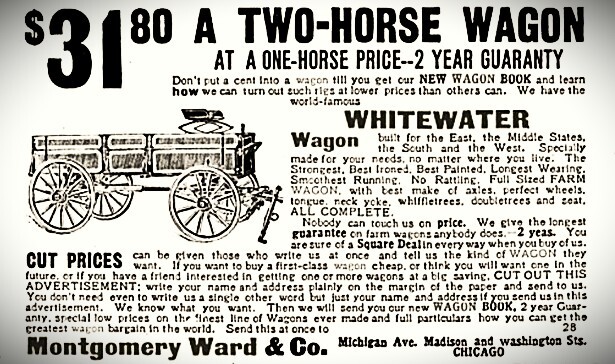
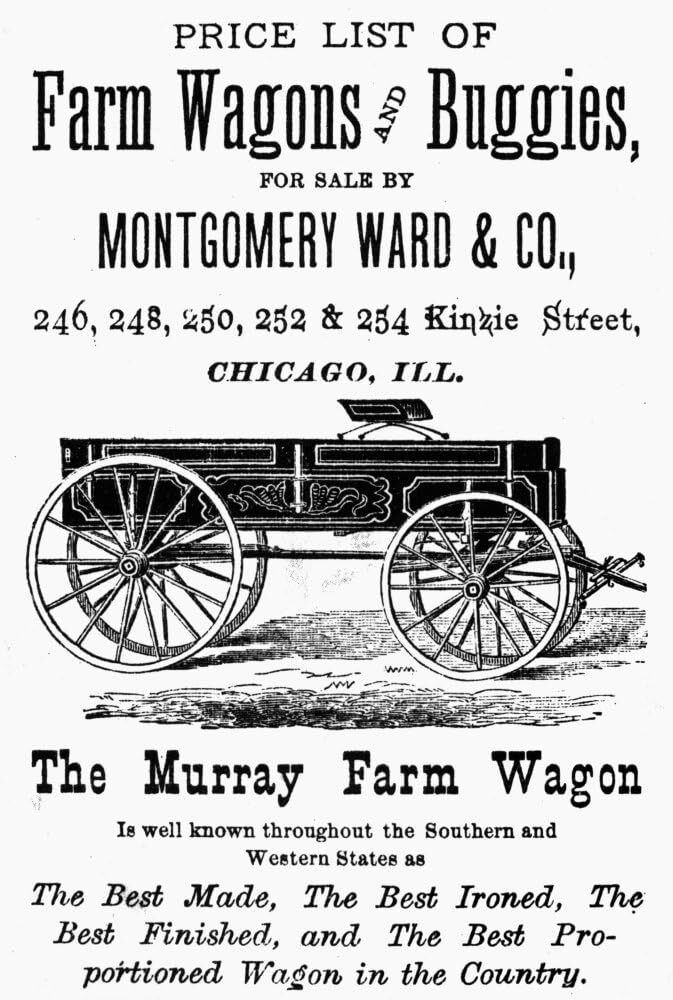
Montgomery Ward promoted their Whitewater-branded wagons as being the "world-famous" brand, seemingly connecting the label to the original, truly legendary Whitewater wagons built in Whitewater, Wisconsin. It was a bit of a stretch to connect these later pieces to those that were directely tied to the Old West. It's a point that today's collectors should be keenly aware of. Shown is a 1905 ad.
The purchaser claimed to our member to have saved $15 to $20 on the wagon, and the latter, not being familiar with the mail order house's catalog and prices, was not in a position to dispute the claim, but the next time such a shipment occurs he will be loaded with facts to show his customer that he has saved nothing by buying from the mail order house.
By reference to the catalog, we find a large cut of farm wagon, and in type nearly an inch long the price $46.80. It is but natural for the farmer who contemplates buying a wagon to think this price is on the size of the one most used in his neighborhood, but on the next page of the catalog appears the price list, which reveals the fact that the price quoted in such bold type is on a 2½ x 8 wagon, without brake, grain cleats, or anti-spreader chains.
(WTWTW Note... this is a smaller, more lightweight wagon without notable accessories that would likely be wanted and needed. Using an analogy related to today's trucks, this example would be similar to listing the price of a compact pickup truck and showing a full-sized, heavier-duty truck).
The price of a 3 ¼ x 10 wagon complete at the factory inIndiana, with 1 ½ x 3/8-inch tire, 10 ½ foot bed, 14 in. lower and 10 in. upper bed, neck yoke, doubletrees and spring seat is $51.80, to which must be added to make the specifications about the same as the majority of wagons sold in the Kansas City territory:
- Extra 2 inches on top box..... $0.60
- Anti-spreader chains............ .40
- Grain cleats.......................... .70
- Gear brake............................ 4.50
$6.20
making wagon cost at the factory $58.00. To this must be added the freight, which to any central Kansas town is about $15.75, making a total cost to purchaser of $73.75, so that in reality the difference is not large and should not be much of a handicap to any dealer who will take the pains to go into detail with his customer.
Of course the buyer, after reading the glowing description of the wagon and the two years warranty, is likely to class it with the best and highest-grade wagon on the market. This suggests saying something about the deception practiced in the description. They make the following claim: "We use second growth white oak in the running gears throughout." Now we have it on the very highest authority that the manufacturer of the best wagons turned out in this country does not claim that his gearing is all of second growth white oak, as such material could not be procured on the market, and while it is true many manufacturers use second growth white oak spokes and occasionally get some of it into the gearing, they make no claim of guaranteeing anything of the kind.
The claim that their wagons are ironed heavier than any wagons of corresponding size made by other manufacturers will be found by examination to have no foundation whatever, and can easily be controverted. Even if true, it would be no indication of superiority, for the best wagons are ironed in the proper proportion, and no more weight is added than is necessary to give the required strength.
Any dealer who meets the catalog house wagon in competition can convince his customer of the folly of sending away for a wagon if he will take down his catalog and show his customer the many points of deception which are so apparent and do a little figuring."
- Implement Dealers' Bulletin
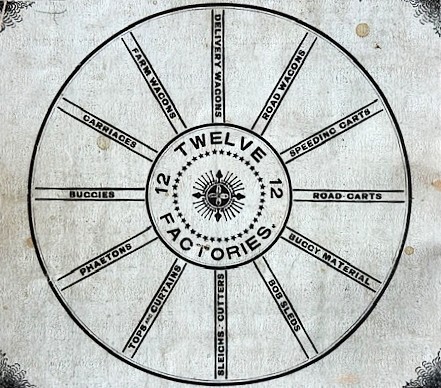
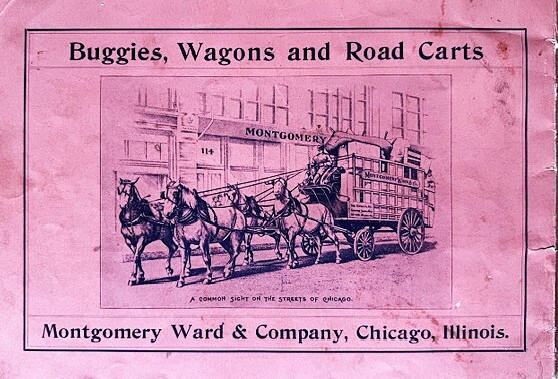
This late-1800s promotion from Montgomery Ward touts the brand's commitment to a wide variety of horse-drawn vehicles. Image Courtesy Wheels That Won The West® Archives.
There's a lot of truth to the thought that time may pass but people and sales tactics can and often do remain the same. Whether we're watching an infomercial about a product that promises incredible results for a fraction of competitor costs or we're simply looking to stretch our dollars as far as they can go, trying to save money can potentially cost us... AND we might just end up with less than we bargained for. It's the same situation for early vehicle collectors. Truly great barn finds are few and far between these days. So, how do we pick the best pieces in a world that's often confusing? I'm glad you asked. I'll be covering similar questions in my talks at the American Chuck Wagon Association's gathering in Granbury, Texas on August 14-15, 2026. We'll cover a lot of territory, and it should prove to be a great experience for all attendees!
In the meantime, we'd love to hear from you and see some of the 'finds' you've uncovered.
Finally, just as a side note for folks looking for a little more info on this dual-name topic, I wrote a related blog to this over a decade ago. It was called 'Rolling History Lessons' and it can be found under the post dated June 10, 2015 in our Archives section.
Have a great weekend!
David
Ps. 20:7