
For the next few weeks, we'll be sharing some period records related to chuck wagons and cattle drives. These firsthand accounts provide even more insights, helping us understand more about the way things were instead of the way we imagine they might have been. Enjoy!
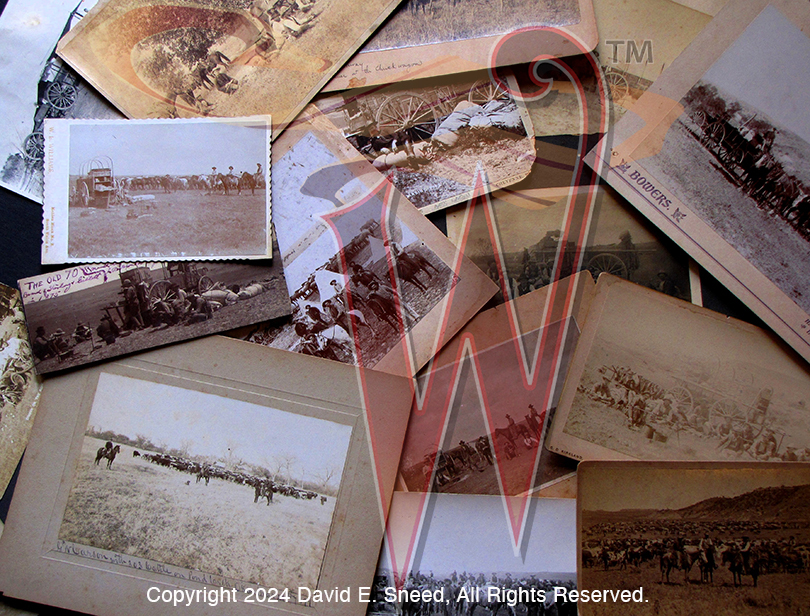
The Wheels That Won The West® Archives contain a sizeable number of original chuck wagon, cattle drive, and ranch round-up images.
Referencing an 1871 cattle drive, J.M. Franks shares this story in his 1924 book, Seventy Years In Texas, page 116...
... After we got across Red River we had little trouble. Grass was good and there was plenty of water. When we got to the Red Fork of the Arkansas River, the river was up and herds were to be seen in every direction waiting for it to go down. Of course, the cattle could swim, but the chuck wagon was the most important part of the outfit and in order to get it across, rafts of logs would have to be made. This was a big job. The bosses of all the herds and some of the hands cut cottonwood trees down, fastened them together with chains, then took one wagon on at a time and floated it across the best way they could. In those days the chuck wagons on the trails were hauled by oxen altogether. From two to three yoke of oxen were hitched to the wagon. Some wagons had trailers. These wagons were to haul the grub for the outfit and blankets and tents. As the Indian territory at that time was all unsettled, we had to lay in enough grub to go through with. Sometimes this would run out. Beeves were used all along, but the main bill of fare consisted of flour, bacons, beans and black coffee.
The cowboys' wardrobe consisted of a little wallet, with about two shirts and two pairs of socks and the same amount of underwear, one blanket and saddle blanket and saddle. Sometimes we had to sleep fully dressed, with the saddle for a head rest, our hats over our faces to keep out the rain. We would hold our horses by the bridle rein, and if the cattle stampeded, we would mount our horses and head off after them as fast as we could go. Such was the life of the old-time cowboy...
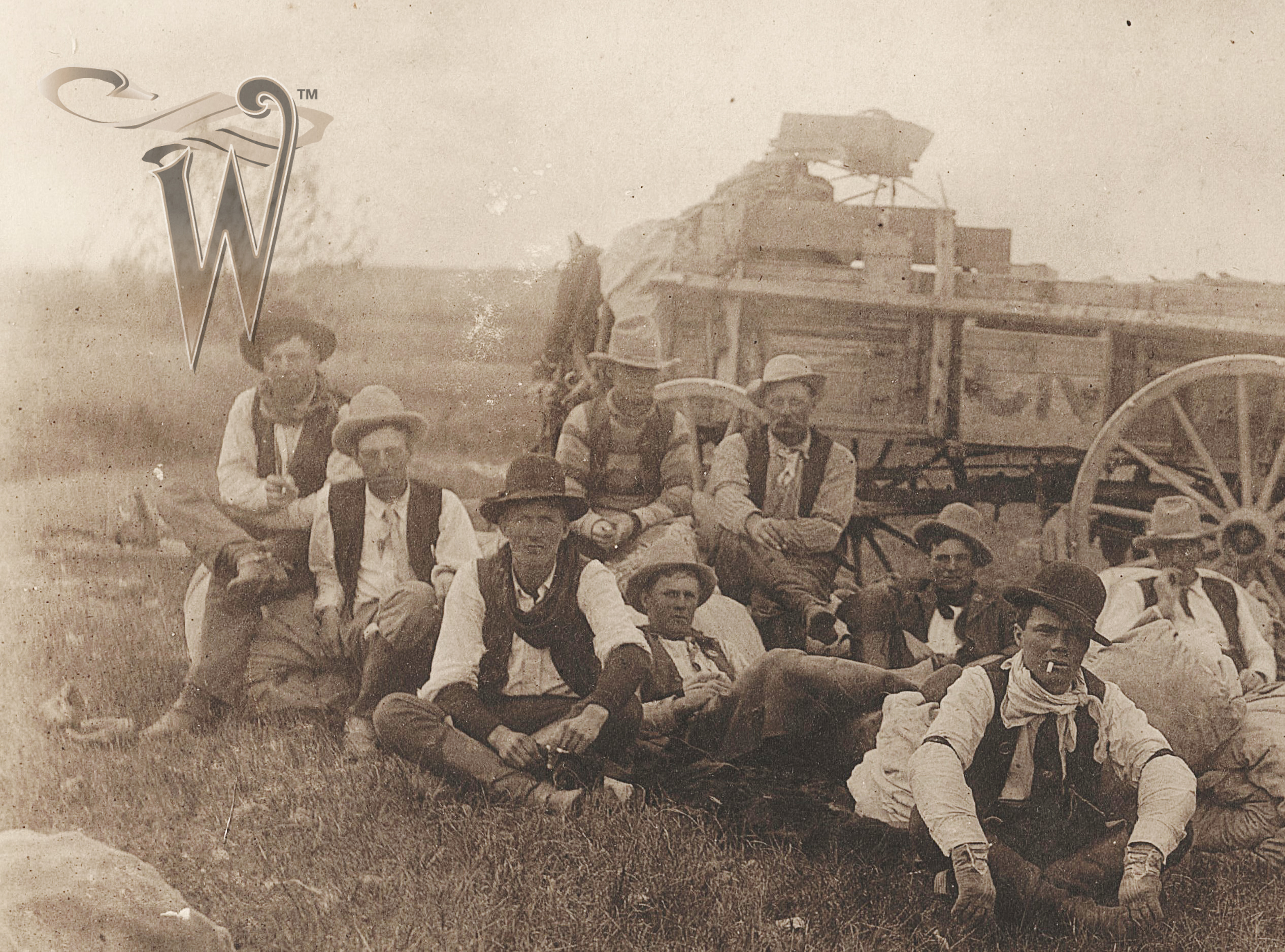
This ranch wagon includes a set of seat risers and what appears to be a banded reach on the running gear. We'll be covering a number of early construction details at the American Chuck Wagon Association gathering in Granbury, Texas August 14-15, 2026. Image Courtesy Wheels That Won The West® Archives.
Another overview of early cattle drives comes from the book, Agricultural History, Volume 1 & 2 published in 1927 & 1928. See pages 180-181...
... The earliest driver, who sought to break the way across the western part of Indian Territory and into Kansas far beyond all settlements, experienced some difficulty owing to their lack of knowledge of the route and the fact that there were no trails or well-known landmarks. Yet no trail boss ever turned back. He merely set the wagon each night with the tongue pointing to the north star and in the morning moved forward with a fixed determination to make his ten or twelve miles that day. In a very real sense, he 'hitched his wagon to a star' and kept his cattle close behind its rolling wheels.
It was not long, however, until well-defined trails grew up and the route became perfectly familiar. Trail driving was eventually reduced almost to a science. It was found by 'trial and error' methods that about 2,500 head was the correct number for a herd. This number required a trail boss, nine cowboys, a horse wrangler, usually a boy fourteen to sixteen years old, and a cook to drive the chuck wagon. Such a herd moved in a column about a mile in length. The trail boss usually rode ahead to survey the ground and search out watering places and good grazing grounds. Next, at the extreme forward tip of the moving column rode two men, one on either side, called the 'point.' This was the station of greatest responsibility since it was these two men who must determine the exact direction taken, or 'point' the herd. It was here too that a stampede always started. A third of a mile back, where the moving column began to bend in case of a change of course, rode two men, one on either side, at 'swing.' A third of a mile still farther back rode two men at 'flank,' while in the rear three men brought up the 'drag.' The horse wrangler accompanied his 'remuda' or saddle band of five or six horses for each man, while the chuck wagon usually followed the herd in the morning and preceded it in the afternoon...
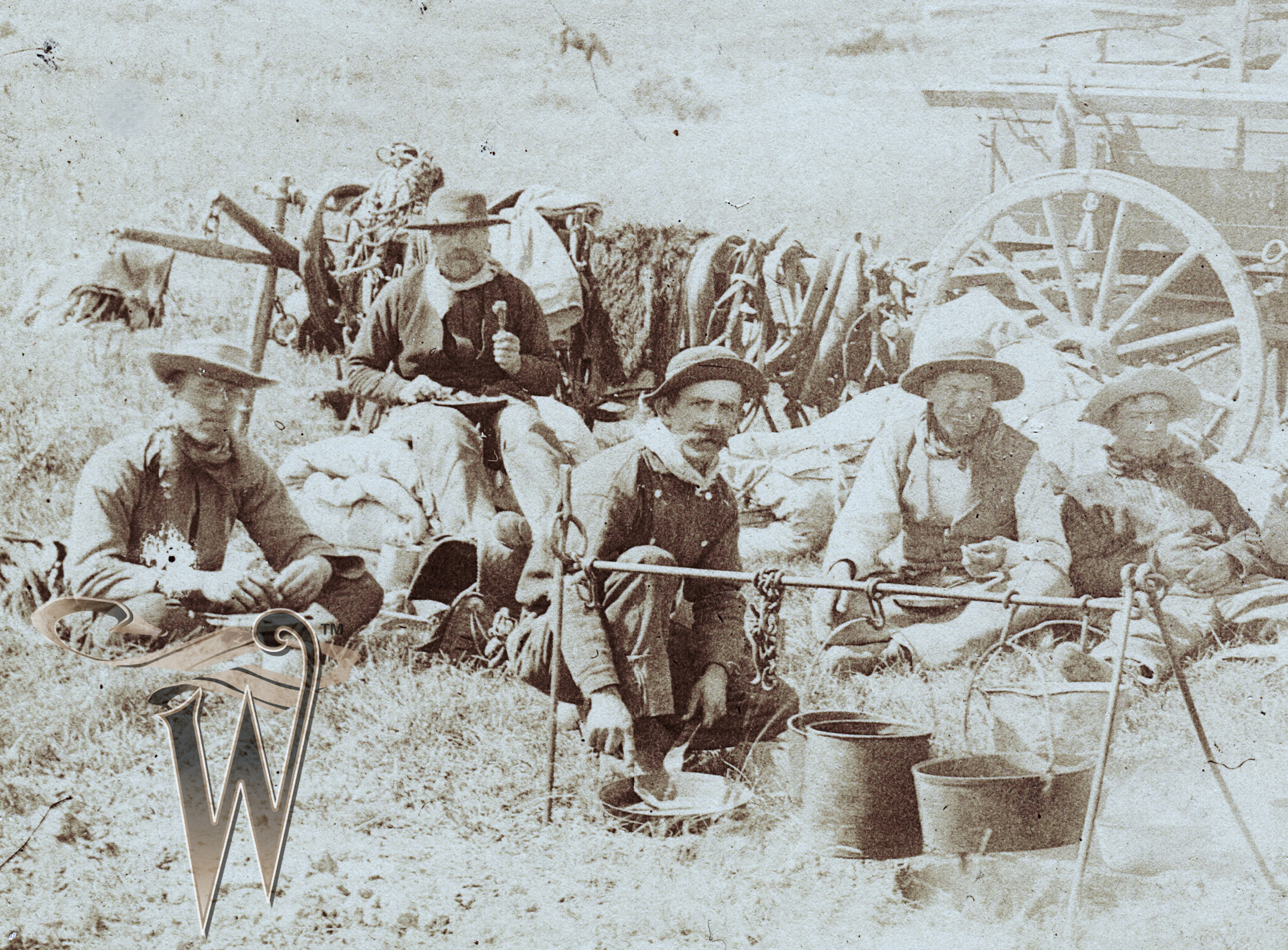
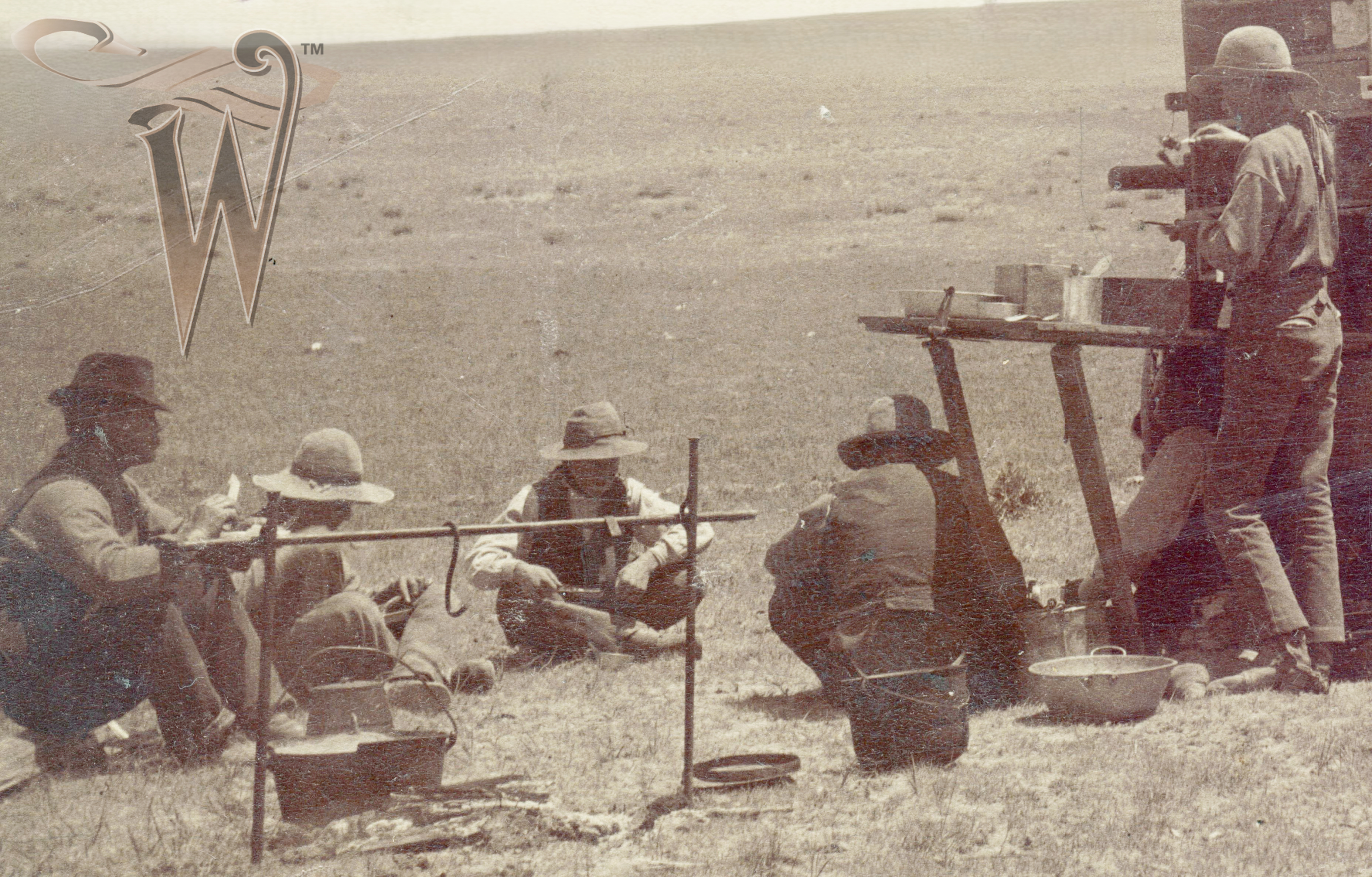
This cropped photo shows a portion of a chuck wagon camp in Wyoming. Note the designs of the campfire irons in this photo and the one immediately below. Images Courtesy Wheels That Won The West® Archives.
Finally this week, are a few numbers from cattle drives roughly 150 years ago. This info comes from page 66 of Albert Handford's Texas State Register for 1876...
Texas Cattle Drive for 1875
The total number driven North this season is, as shown by the reports, 151,618, including all kinds of Texas beef. In 1874, the total drive out of Texas amounted in round numbers to 166,000 or 14,400 more than have thus far this season passed over the trail. The greater part of this drive last year was over by the 1st of July, the heaviest having passed between April 15 and June 10. After July 1, about one quarter of the total drive passed Fort Worth. These facts, together with the other fact that large numbers of cattle have been driven from the Mexican frontier to North-western Texas to avoid raiders, and are now on the range, from which they can be put on the trail northward as soon as the condition of the market shall fully warrant, sustain the prediction that the drive of this year will exceed that of the last.
The next couple weeks will have a two-part account of a cattle drive experience that many will be at least somewhat familiar with. Nonetheless, the addition of firsthand details always helps us appreciate the intensity and severity of those legendary parts of our past. Stay tuned!!
David
Ps. 20:7